Best Board Books for 2-Year-Olds Who Ask Why About Everything
Two-year-olds ask why for two reasons. One is the obvious one, they want information. The other is the one most parenting books skip: they have just discovered they can steer a conversation. The why is a tool, and they are testing what it does.
The first impulse is to answer every question carefully. Don't. Answer some. Redirect others. The skill you are actually teaching is not "I will deliver a correct answer to every question you ever ask me." It is "you and I can wonder together, and we can use a book to do it."
If you want a head start, the complete STEM board-book library for toddlers is built around exactly this kind of why-driven reader.
What a good board book does for the curious toddler
The board books that work at this age share three features.
- A character the toddler can hold onto. Not "a character introduced on page one." A character whose face the toddler will recognize ten pages in, on a different background, doing a different thing. Continuity is the gift consistency-loving toddler brains crave.
- One question per book. Picture books for older kids can carry three threads. Board books for ages 2 to 3 can carry one. "What does Kit notice?" That is enough.
- A pause for the toddler to answer. Good board books leave space inside the question. They do not fill it.
What to look for on the shelf
Reading aloud to a two-year-old is a partnership, not a performance. Look for books that:
- Have thick pages with rounded corners, your toddler will turn them, drop them, drool on them, and stack them. The book has to survive.
- Use one or two sentences per page, not paragraphs. Toddlers do not have paragraph-shaped attention spans.
- Center one feeling or one verb, noticing, wondering, asking, building. The book that tries to teach three feelings at once teaches none.
- Have open-ended endings that hand the next move back to the reader.
Why I wrote 20 of them instead of one
The four-year-old who can ask why also wants to know what happens next. A single board book about curiosity is a pamphlet; twenty of them, in order, is a curriculum. Phase 1: Wondering alone is four books that build on each other. By Book 4, the toddler has met the same characters in four different situations and is ready to meet the rest of the world.
I wrote Kit's Little Sparks because I had read every other board book in this corner of the bookstore. They were good. None of them was a series the way a four-year-old experiences a series, same characters, growing emotional range, a destination at the end. I wanted that for my own preschool classroom. So I built it.
Three books to start with
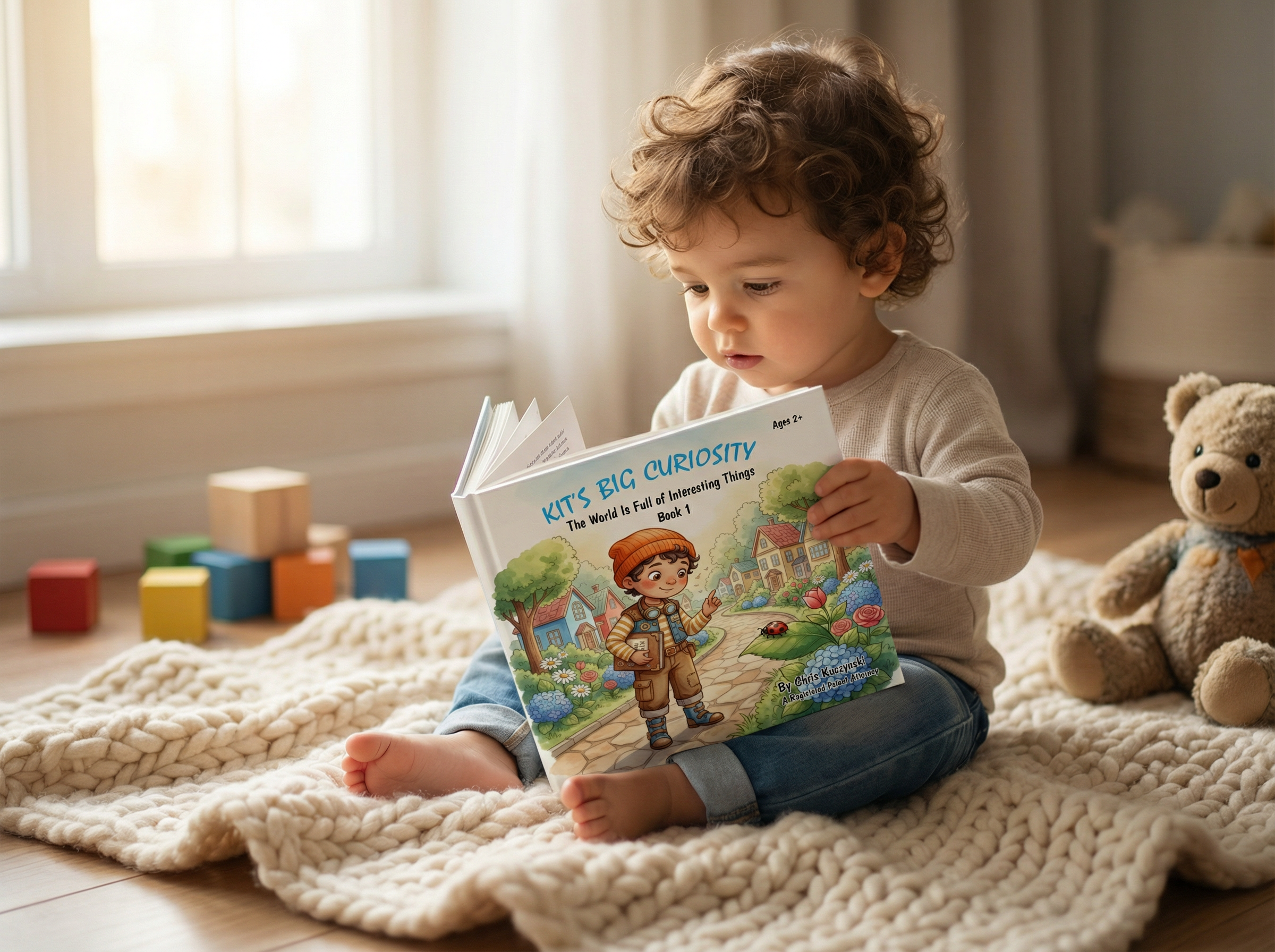
- Kit's Big Curiosity, Book 1. The whole series starts here. A toddler discovers that the world is full of interesting things.
- Kit Sees A Puzzle, Book 3. The reframe that does the most psychological work: problems are puzzles, and puzzles are fun.
- Kit Has Feelings, Book 4. Empathy is a prerequisite, not a soft add-on.
How to read these out loud
Three tips, ranked by how much they will help you tomorrow morning.
- Read slower than feels natural. The pause IS the lesson.
- When the toddler asks a question mid-book, answer the question and then re-read the page. The page is not the lesson plan. The conversation is.
- Let the toddler "read" it back to you. They will narrate from memory and from pictures. That is the goal.
If you want to hear how the cadence sounds done right, every book has a free read-aloud at littlesparksbooks.com/pages/resources, scan the QR code in the back of any print book.
Chris Kuczynski is a registered United States patent attorney with over 20 years of experience, a University of Washington engineer, and the cofounder of a preschool in Carlsbad, California. He writes the Kit's Little Sparks book series, available in ebook, paperback, and hardcover. The board book edition is on the waitlist.

Written by Chris Kuczynski