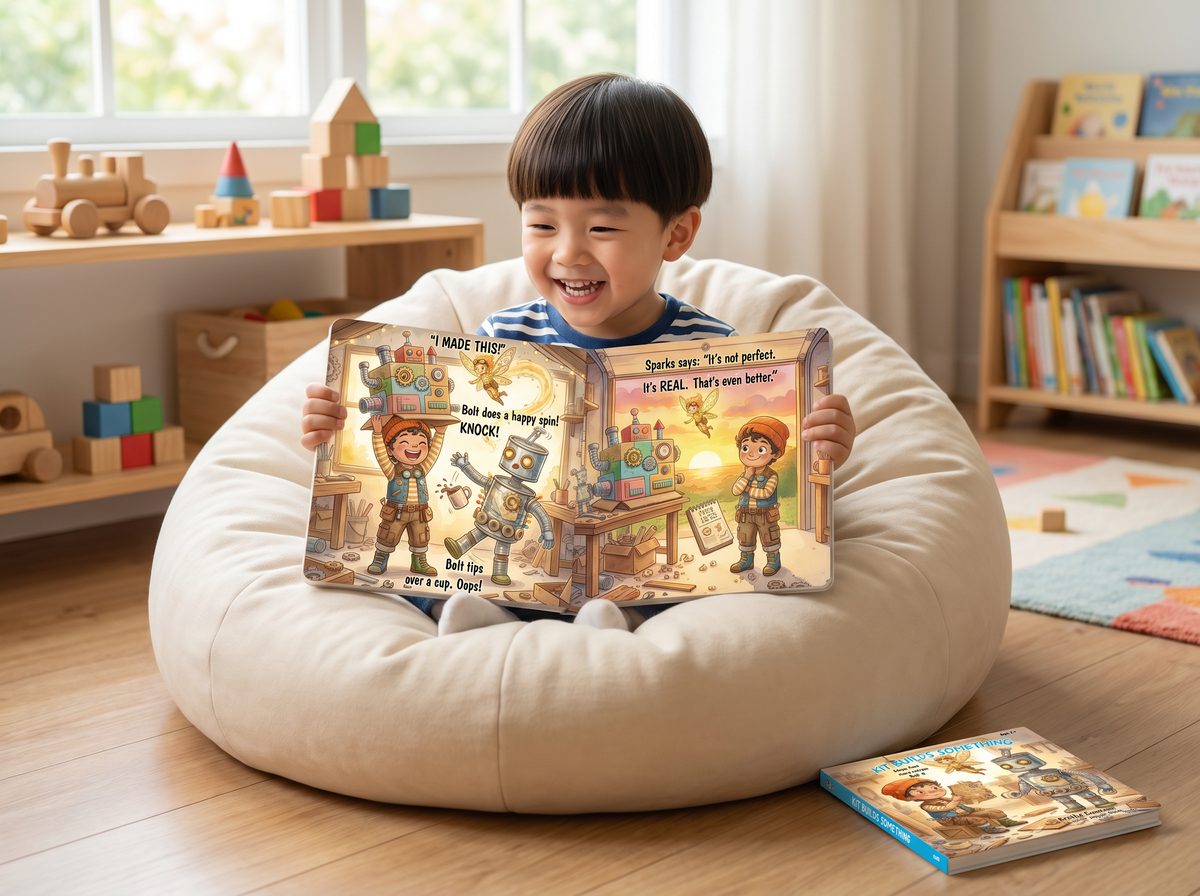
Cardboard and Tape Are the Curriculum: Play-Based Learning, DAP, and Books 5 to 8
Bolt hands Kit cardboard. Bolt hands Kit tape. Bolt hands Kit more tape. That is most of Book 6: Kit Builds Something, and it is the most defensible page in the series, because the biggest professional body in early childhood education says that is how learning is supposed to happen.
Where the topic comes from
NAEYC's Developmentally Appropriate Practice position statement, adopted by its governing board in April 2020, is the document the field organizes itself around. It defines developmentally appropriate practice as methods that promote each child's optimal development and learning through, in its own words, "a strengths-based, play-based approach to joyful, engaged learning." Play is not the reward after the lesson. Play is the lesson. NAEYC keeps a standing Play topic hub for the same reason.
California agrees in its 2024 Approaches to Learning foundations, which include a section for teachers titled "Creating Opportunities for Play" and treat open-ended materials as the way children practice initiative, engagement, and problem-solving.
What play-based looks like in Books 5 to 8
The Making phase of the series is four books long because a build has four parts, and each one is a kind of play.
- Book 5: Kit Draws an Idea. Marco, a boy covered in marker smudges, has one rule: don't worry if it's squiggly, just draw. Kit's first shape is wobbly. Marco calls it perfect. By the end the sketchbook is a beautiful mess and one squiggle looks like something.
- Book 6: Kit Builds Something. Cardboard, tape, more tape. The result is lumpy and the tape shows everywhere. Sparks says the line the book exists for: "It's not perfect. It's REAL. That's even better."
- Book 7: Kit Tries Again. It collapses. The twins turn every crash into "OOPS! ALMOST!"
- Book 8: Kit Makes It Better. Devi fixes one thing at a time until the same cardboard works well.
Nobody in those four books is taught a fact. Nobody is handed a kit with numbered parts. A child draws, builds, breaks, and fixes with materials that were in the recycling bin, and an adult says "perfect" at the wobbly stage instead of the finished one.
What you can do
- Keep a build bin: cardboard, masking tape, paper cups, a few clothespins. No instructions in the bin. The instructions are the child.
- Say Marco's word at the first scribble. "Perfect." Then hand over another sheet. The second drawing is always bolder than the first.
- Do not fix the lumpy thing. Ask what it does. A tower that leans is a tower that leans; a child who explains it is learning to communicate a design.
Each of the four books has a free educator guide with a classroom version of the build. The Book 6 one is mostly tape.
Sources
- NAEYC, Developmentally Appropriate Practice, position statement adopted April 2020. Web version at naeyc.org. Original PDF. Archived copy on littlesparksbooks.com (PDF), saved in case the original moves.
- NAEYC topic hub, Play. www.naeyc.org/resources/topics/play
- California Department of Education, California Preschool/Transitional Kindergarten Learning Foundations: Approaches to Learning (2024). Original PDF. Archived copy on littlesparksbooks.com (PDF), saved in case the original moves.
Chris Kuczynski is an engineer turned registered patent attorney, a preschool co-founder, and a dad. He is the author of Kit's Little Sparks, a 20-book STEM series that gives children ages 2 to 4 the social and emotional foundations of the inventor's mindset. It is the first of four age-tiered series for readers ages 2 to 12.

Written by Chris Kuczynski