Article: Two Names on One Creation: Problem-Solving Together in Books 11, 14, and 19
Two Names on One Creation: Problem-Solving Together in Books 11, 14, and 19
As a patent attorney I have reviewed thousands of patents, and a surprising number of them list more than one inventor. One person sees the whole picture, another figures out how the pieces fit. So when a standards document for four-year-olds names collaboration as a learning skill, it is not being soft. It is describing how real inventions get made.
Where the topic comes from
The 2024 California Preschool/TK Learning Foundations close the Approaches to Learning domain with a strand called Goal-Directed Learning. It has two sub-strands: Problem-Solving and Collaborative Effort. The pairing is the point. Solving a problem alone and solving it with a partner are treated as two skills, and the second one has its own foundation statement.
NAEYC's DAP guidelines put the same idea first among the six areas of practice: creating a caring community of learners. A classroom where children build with each other, not just next to each other.
Three books, three kinds of together
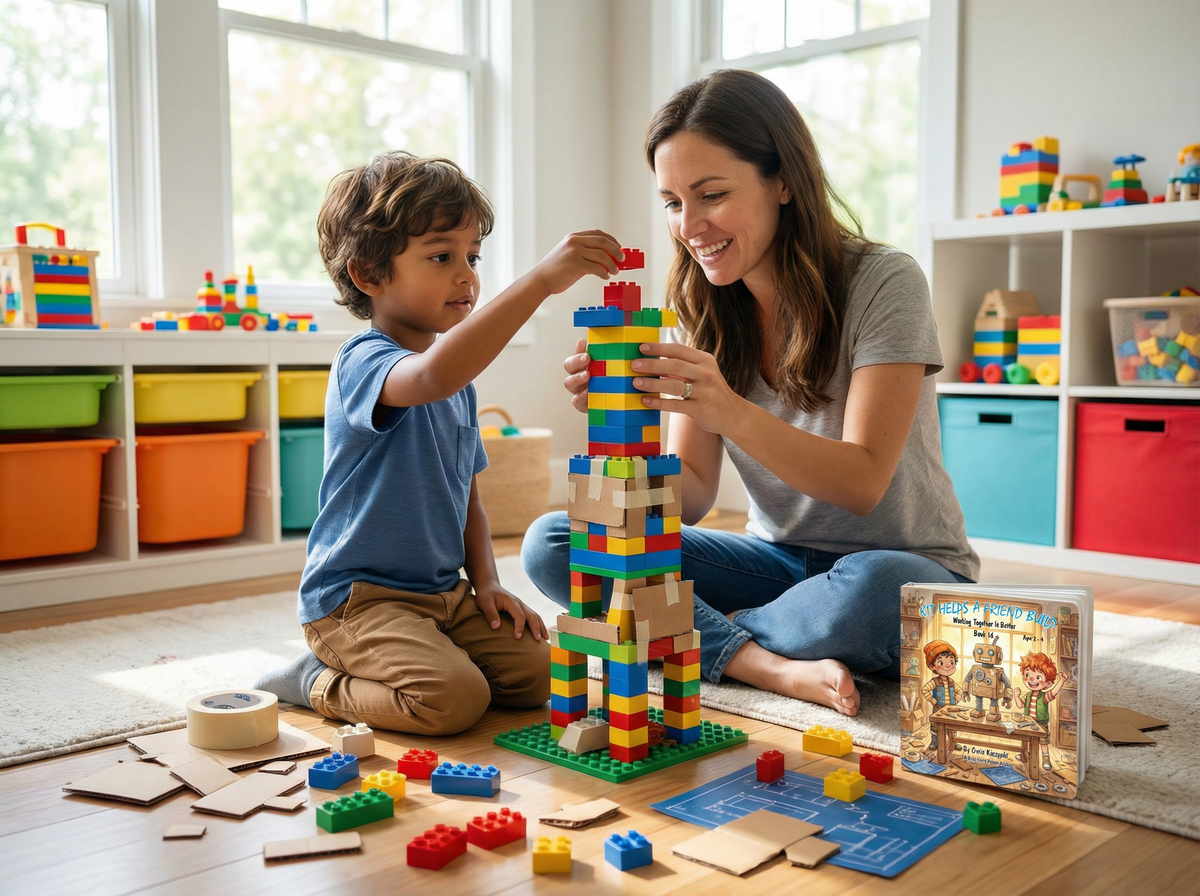
Book 14: Kit Helps a Friend Build is the direct one. Milo is bursting with ideas he cannot build alone. He and Kit clash first, the way two four-year-olds with two plans do. Then they find that combining strengths beats competing, and by the last page two names are signed on one creation. That last image is the whole book: not "we shared," but "we both made this, and it says so."
Book 11: Kit Shares With a Friend is the harder one. Zara runs a lemonade stand and wants to borrow the Steady Sippy. Kit's tummy feels funny. The book takes that feeling seriously. Sharing does not mean giving something away forever. Sharing means choosing how, together, with rules both kids agree to. Collaboration starts with a negotiation, and the book lets a toddler watch one.
Book 19: Kit Helps Lily is the one where Kit has to hold back. A tiny girl named Lily brings a stuffed bunny that keeps falling off her bed. Kit almost starts building. Instead he kneels to her level, hands her a crayon, and helps her fix it herself. When it collapses and her chin trembles, he does not take over. "ALMOST! Let's fix one thing." The Bunny Hammock is Lily's, and she says so: "I MADE THAT!"
What you can do
- Run a two-person build with one rule: both names go on it. Tape, cardboard, one goal. Watch where the clash happens, then watch what they do next.
- When one child wants to borrow, ask Zara's question out loud. "What are the rules?" Let them make three.
- Try Kit's move from Book 19 once this week. When a younger child asks you to fix something, hand them the crayon first.
The educator guide for Book 14 includes a "Build Together" take-home sheet, and its classroom activities are built for pairs. Milo, by the way, sometimes wears hearing aids, and Kit faces him when they talk. There is no lesson about it inside the story. It is just how the friends talk.
Sources
- California Department of Education, California Preschool/Transitional Kindergarten Learning Foundations: Approaches to Learning (2024). Original PDF. Archived copy on littlesparksbooks.com (PDF), saved in case the original moves.
- NAEYC, Guidelines for Developmentally Appropriate Practice in Action (the six areas of practice). www.naeyc.org/resources/position-statements/dap/guidelines
- California Department of Education, California Preschool/Transitional Kindergarten Learning Foundations overview page (nine domains). www.cde.ca.gov/sp/cd/re/psfoundations.asp
Chris Kuczynski is an engineer turned registered patent attorney, a preschool co-founder, and a dad. He is the author of Kit's Little Sparks, a 20-book STEM series that gives children ages 2 to 4 the social and emotional foundations of the inventor's mindset. It is the first of four age-tiered series for readers ages 2 to 12.

Written by Chris Kuczynski