

How NGSS Science and Engineering Practices Show Up in 20 Toddler STEM Books
The Next Generation Science Standards (NGSS) define eight Science and Engineering Practices that K-12 students should develop. They are the verbs of being a scientist or engineer.
You will sometimes hear that NGSS is K-12 territory and does not apply to preschool. That is bureaucratically true and developmentally wrong. The practices begin much earlier. By ages 2 to 4, toddlers are already doing most of them in rough form. The job of a good preschool curriculum is to recognize the practices in toddler behavior and scaffold them so they survive into kindergarten.
Kit's Little Sparks was designed as a 20-book curriculum that maps each developmental phase to one or more NGSS practices. Here is the map.
Practice 1: Asking Questions and Defining Problems
The first NGSS practice is the most natural for toddlers. Toddlers ask why several hundred times a day. The work is to channel that into spotting a defined problem.
- Book 1: Kit's Big Curiosity, noticing
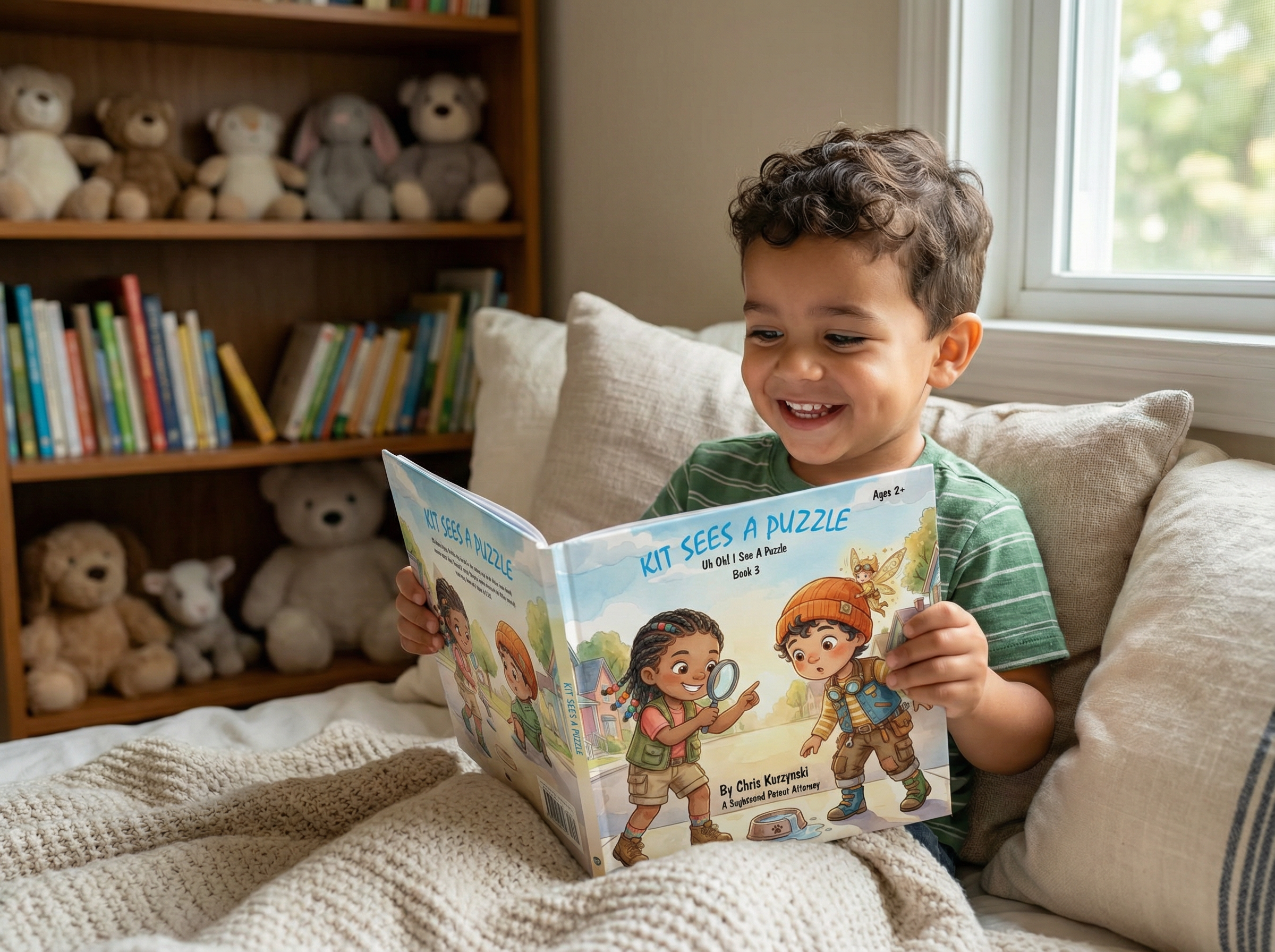
- Book 3: Kit Sees A Puzzle, defining problems as puzzles
Practice 2: Developing and Using Models
For toddlers, "model" means "drawing." The leap from picturing something in your head to putting it on paper is the foundation of every engineering practice that follows.
- Book 5: Kit Draws An Idea, scribbles as models
Practice 3: Planning and Carrying Out Investigations
For toddlers, an investigation is "I am going to try this thing." Tape, cardboard, glue. The investigation is the build.
- Book 6: Kit Builds Something, turning a model into a real thing to test
Practice 4: Analyzing and Interpreting Data
"It fell apart" is data. "It works but the tape comes loose" is more refined data. Books 7 and 8 are the data interpretation phase of the curriculum, and Book 7 gives the feeling its own beat first. The invention collapses and Kit's lip wobbles. Then Sam builds a tower, it crashes, and he shouts "OOPS! ALMOST!" Suki looks at the wreckage and finds the one thing to fix. That is data interpretation with a grin on it.
- Book 7: Kit Tries Again, interpreting failure
- Book 8: Kit Makes It Better, iterative refinement
Practice 5: Using Mathematics and Computational Thinking
At ages 2 to 4 this practice is mostly counting and noticing patterns. The series does not foreground math. Counting and sequencing live in the activity page at the back of each book and in the free activity sheets behind the QR code. Book 1's activity is a walk where the child counts every "ooh."
Practice 6: Constructing Explanations and Designing Solutions
This is where Phase 2 (Making) lives. By Book 8, the toddler reader has watched Kit run the draw-build-test-fix loop four times. The fifth time, they will do it themselves with a cardboard tube.
Practice 7: Engaging in Argument from Evidence
A surprising place this practice shows up for toddlers: handling a copycat. The argument from evidence at age 4 is "I made it first. Look, my gear is on it." Kit's mark is a gear. Josie's is a star. Nobody needs the word "trademark" to follow that.
- Book 12: Kit's Special Stamp, marking your work so everyone can tell it is yours
- Book 13: Kit And The Copycat, talking it through with the other person instead of grabbing
Practice 8: Obtaining, Evaluating, and Communicating Information
Show and tell is the toddler version. Telling someone what you made and why is exactly this practice in its earliest form.
- Book 17: Kit's Show And Tell, communicating
- Book 19: Kit Helps Lily, teaching someone else as the highest form of communicating
Free educator guides
Every book has a free educator guide with circle-time discussion questions, six activities adapted for the classroom, a matching family activity sheet, and a standards table that maps the book to NAEYC, the NGSS practices, and CASEL. Start at our Educators page.
Chris Kuczynski is an engineer turned registered patent attorney, a preschool co-founder, and a dad. He is the author of Kit's Little Sparks, a 20-book STEM series that gives children ages 2 to 4 the social and emotional foundations of the inventor's mindset. It is the first of four age-tiered series for readers ages 2 to 12.

Written by Chris Kuczynski

%20define%20eight%20Science%20and%20Engineering%20Practices%20that%20K-12%20students%20should%20develop.%20They%20are%20the%20verbs%20of%20being%20a%20scientist%20or%20engineer.%0A%0AYou%20will%20sometim...)